
A Glittering Future Woven by Hand
On Koh Samui, where craft is often overshadowed by tourism gloss, one woman stands out as the island’s only glitter-batik artist. Her work – measured and rooted in tradition yet unmistakably her own – mirrors the pateh sarong’s enduring place in southern Thai life.
Words: Mimi Grachangnetara
Photos: Nattapol Suvapat
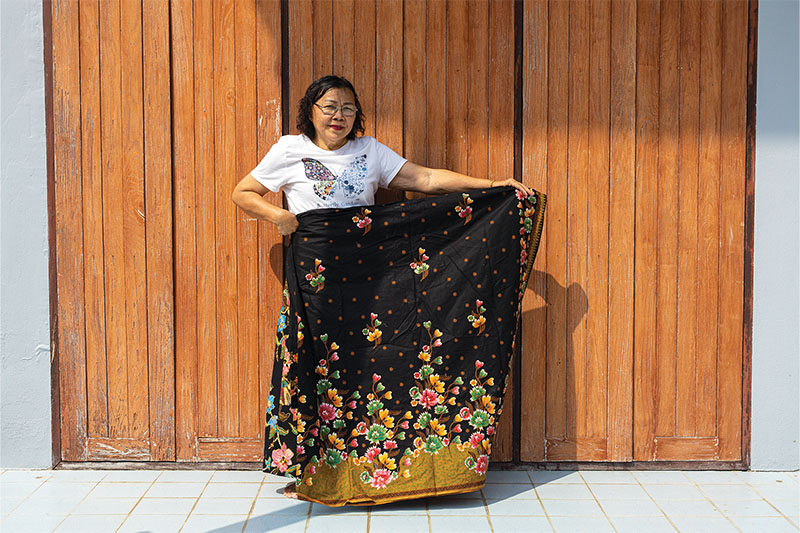
In Thailand’s deep south, the pateh, or batek sarong, is an emblem of belonging. Worn as a wrap, gifted at ceremonies, or packed into the luggage of those travelling north for work, the textile is a soft ambassador of the region’s identity. The patterns of the batik sarong— rendered in wax and pigment represent a unique cultural geometry, serving as a lived vocabulary of elegance. To wear one is to embrace a tradition that is as utilitarian as it is beautiful.
In recent years, as global tastes shift toward craft with provenance, the pateh has been quietly reasserting itself. You’ll find it in boutique hotels in Nakhon Si Thammarat, slung across chairs in Trang cafés or fashioned into cushions in Samui’s design-forward villas. But its resilience depends not on trend cycles, but rather, on the patience and passion of the artisans who keep the colours alive. One of them is Sureerat Jitmoong, who, at 63, found her second life after returning home.
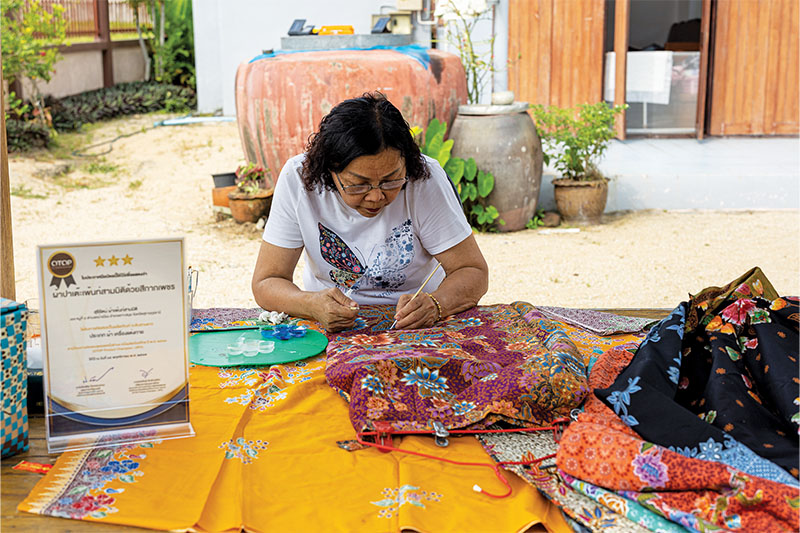
Her story begins in Nakhon Si Thammarat, pauses in Samui, detours through early retirement in Khanom district, and circles back home again. “I came back to care for my mother,” she says simply. Her father had passed away when she was 56, and with COVID-19 arriving years later, she became her mother’s lone caretaker — cooking rice, keeping the household steady, and trying to fend off the quiet boredom brought by the island’s long lockdowns.
Like many southern women, she first turned to food: kanom kai pla (fish roe snacks) made from an ancient family recipe, and pui fai (chiffon with Thai custard). Her snacks earned an OTOP (One Tambon One Product) label, but the work was demanding. Then a relative suggested a government vocational programme in Ang Tong province, which offered free workshops. One category caught her eye immediately: batik.
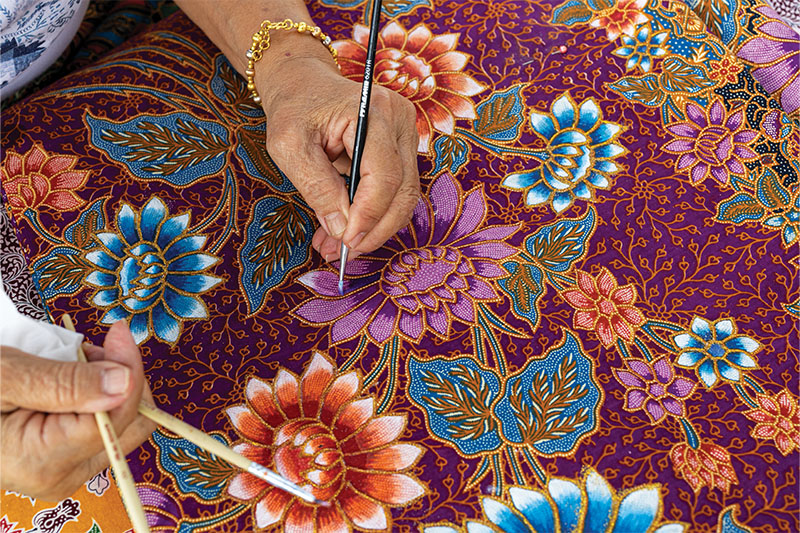
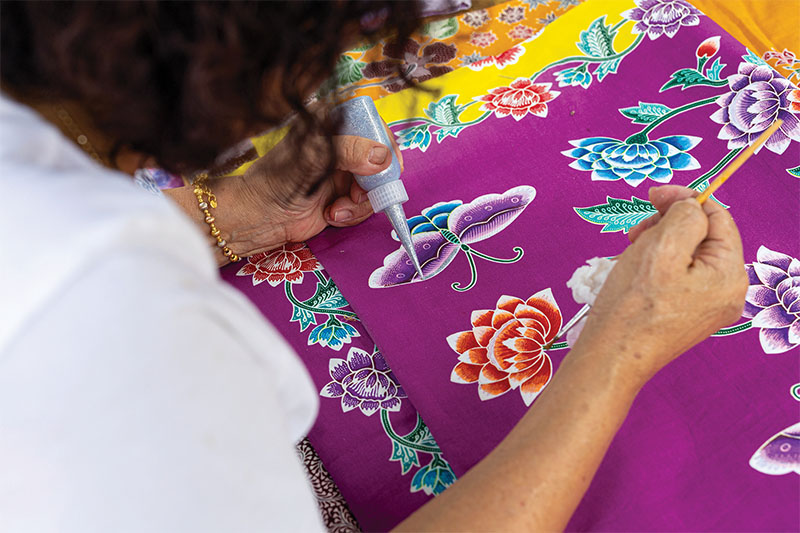
“I’m a southerner — so I have an innate love for pateh,” she says. But Sureerat was particular. The workshop used low-cost Chinese pigments that faded too quickly. She wanted colours with longevity — pigments with conviction, so she travelled to Phuket and Trang provinces, searching out see kaak pet, a glitter-based textile paint with a lacquer-like sheen, closer to what one might find in nail varnish. That journey led her to a master of the arts, known by the term Kru Changsin Hang Pandin, who had pioneered this shimmering technique for more than fifteen years.
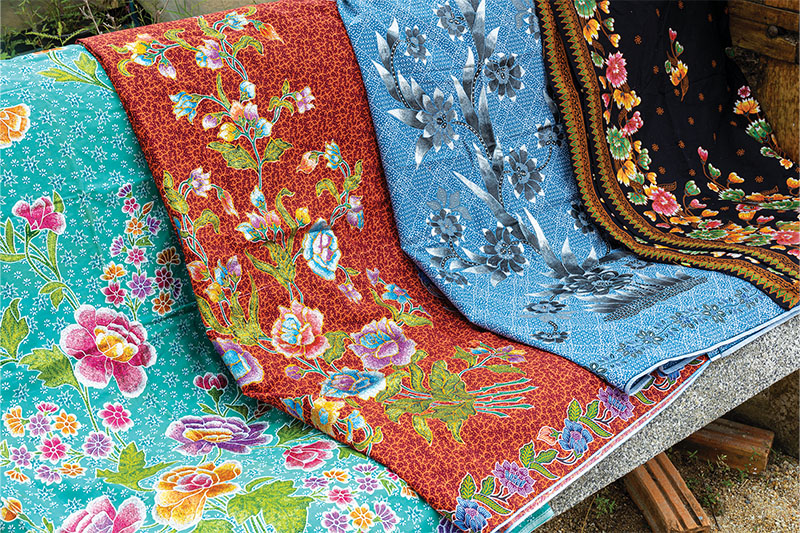
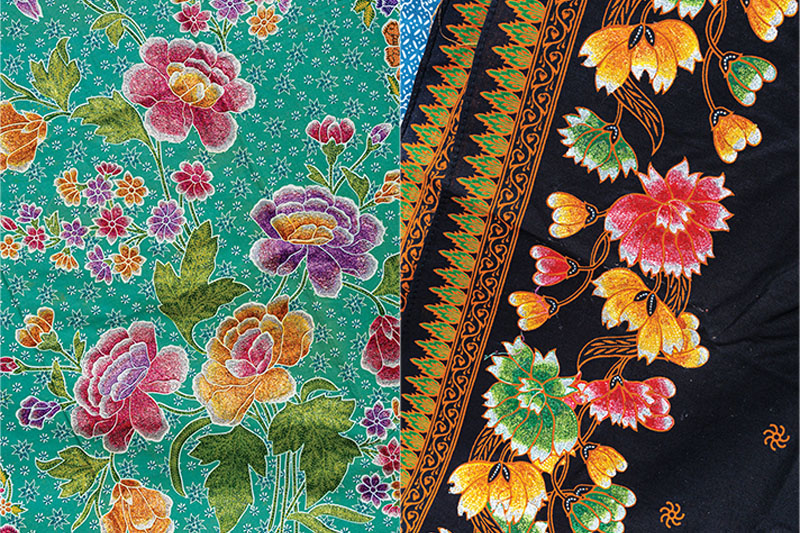
Training with him wasn’t cheap. “But I really wanted to learn,” Sureerat smiles. She paid for two full days — intensive lessons on acrylic bases, colour gradation from light to dark, and the discipline of allowing each layer to dry before adding the next. Flowers must appear lifelike, she explains. Shadows must sit exactly where they belong. The acrylic forms the under- painting; the kaak pet is the light- catching final act.
Each textile takes three to five days to complete. More, if the rains set in and the colours thicken stubbornly in the humidity. She paints only when she has the right samati — the clarity of mind essential to her craft. “If my mood is wrong, I can’t work. If I make a mistake, I cannot fix it.”
Her tools are simple but chosen with care. While most batik artists rely on brushes fully, Sureerat adjusts techniques depending on how the glitter paint behaves. Good fabric is essential — cotton without polyester, cut for sarongs or larger wrap cloths. She treats finished works like silk.
No two pieces are alike. Some, she says, require dern sen, a technique that creates a subtle three-dimensional outline, giving her flowers and leaves a sculptural lift. Her most intricate floral patterns can fetch 8,000 baht, though standard pieces usually start around 1,500 baht. These creations are only affordable luxuries for those who understand the time and temperament required to make them.
She sells quietly through a mobile phone application and to locals who know what they’re looking at. Tourists, she says, often don’t recognise the cultural value — though one of her pieces once graced a small island fashion show.
Alongside her batik practice, Sureerat still tends her durian and rubber plantations and makes occasional southern snacks. But painting remains her solitude. “I need to be alone,” she says. “It’s my peace.”