Ghosts of the Canopy
Shy, endangered and fleetingly visible, the dusky leaf monkey offers a rare glimpse into the fragile wild heart of southern Thailand.
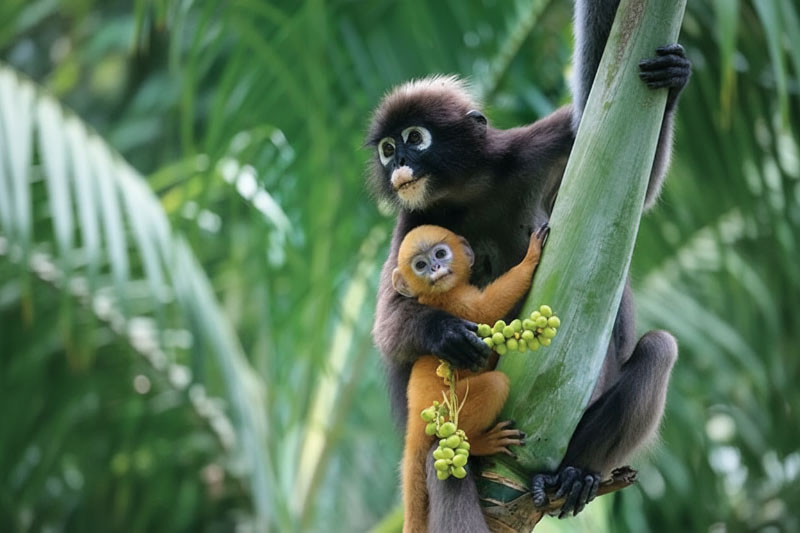
At the edge of Ang Thong National Marine Park, where limestone islands rise from a glass-calm sea, dusky leaf monkeys (Trachypithecus obscurus) — also known as the spectacled langur, or kaang wan in Thai — sometimes emerge from the forest canopy. Their movements are quiet and deliberate, set against a backdrop of sand, sea and mangroves.
Shy by nature, these monkeys are easily recognised by the pale rings encircling their eyes and usually retreat at the first sign of human presence. Under ideal conditions, however — gentle weather, minimal disturbance and abundant food — they may briefly reveal themselves. Around May in Ang Thong National Marine Park, mothers can sometimes be seen carrying vivid orange infants, a striking contrast to the adults’ muted grey-brown fur.
The species is listed as Endangered (EN) by the International Union for Conservation of Nature (IUCN), following significant population declines driven by habitat loss, including forest clearing, agricultural expansion, and hunting for the pet trade. Although found in parts of Thailand, Malaysia and Myanmar, the dusky leaf monkey remains under increasing pressure. As leaf-eating, tree-dwelling primates, they play an important role in forest ecology through seed dispersal, making their decline particularly concerning.
Visitors lucky enough to encounter these animals are urged to observe from a distance of at least 10 to 15 metres, keep noise to a minimum and secure all food and drink. Feeding wildlife or approaching too closely can disrupt natural behaviour and threaten the delicate balance that allows these rare primates to survive.