The Hands That See
His eyes are only part of the story. On Koh Samui, a blind coconut peeler’s hands have become his greatest guide, carrying the wisdom of a lifetime spent perfecting an age-old craft.
Words: Mimi Grachangnetara
Photos: Jiraphol Rikshasuta
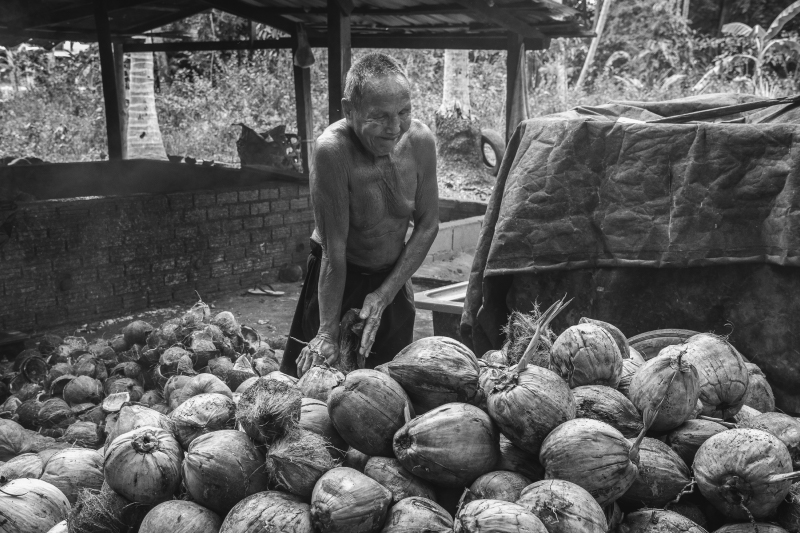
A coconut barely touches the blade before its thick husk falls away in one clean motion. Seated on a low wooden stool in Lamai, Yokjing Sae-lim works with a speed and certainty honed over a lifetime. His hands move before his mind seems to catch up — a twist, a pry, a flick of the wrist — and the husk comes away in a single clean motion. He has done this so many times that the number stopped meaning anything to him decades ago. He is 79 years old. He has been blind since he was two.
Yokjing’s family came from China more than thirty years before he was born into this pocket of Thailand’s Gulf coast, on an island that would one day fill with resorts and rooftop bars but was, when he arrived, simply a place of coconut groves and fishing boats. His mother died a month after giving birth to him — a casualty, as he tells it, of the island’s meagre public health system at the time, when there was no proper clinic, no real hygiene, nothing to catch what went wrong. Not long after, he caught a childhood illness related to malnutrition the locals call rok saang, a fever the old Thai folk medicine tried and failed to reach in time. It settled behind his eyes and never left. He was two years old, and the world went dark and stayed that way.
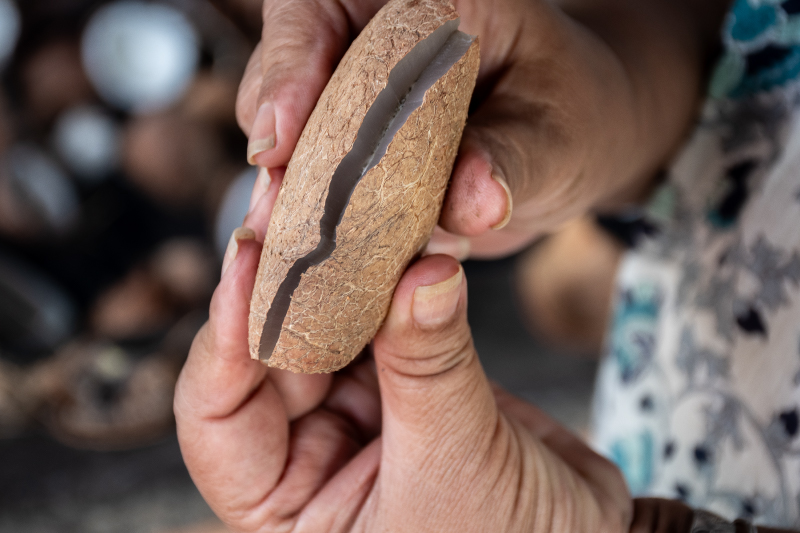
His father raised him alone for a time — until he too died, when Yokjing was 31. By then Yokjing had long since learned that no one was going to do his living for him. A local coconut farmer, seeing a boy who needed a trade, taught him to peel at fourteen. There were cuts, plenty of them, in those first years — a blind teenager learning to read a blade by feel, learning where his fingers ended and the husk fibre began. He carries the scars still, small white marks across knuckles that have since peeled easily more coconuts than most people will see in a lifetime.
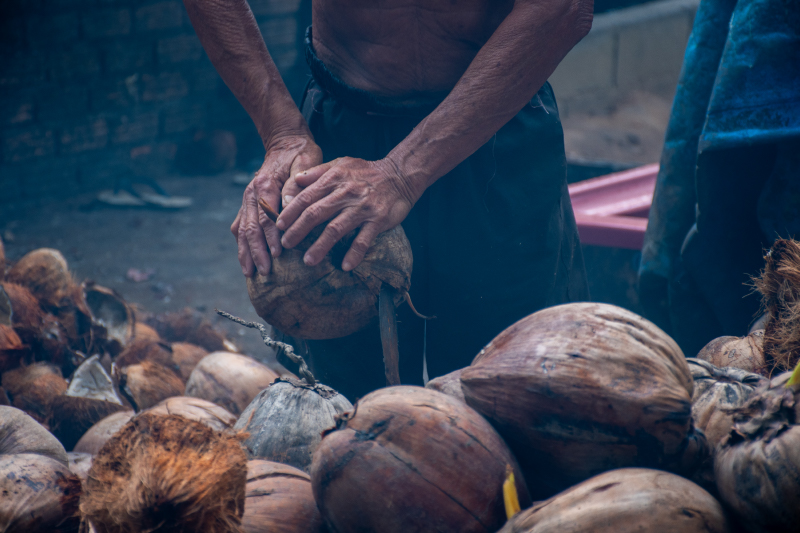
What Yokjing does with his hands looks, at first, like simple manual labour: coconuts pried from their husks, split from their shells, the meat scraped and dried, sent off in sacks to Bangkok, where the coconut milk trade has always had an appetite for Samui’s harvest. He sells the fresh peeled coconuts for five to ten baht each. But watch him longer, and something else becomes clear. His hands are not simply doing a job. They are the only eyes he has ever had, and over sixty-five years he has taught them to see extraordinarily well.
Not every coconut on the island is fit for trade. The small ones, the cracked ones, the ones that fall wrong from palms that have stood for a hundred years and grown
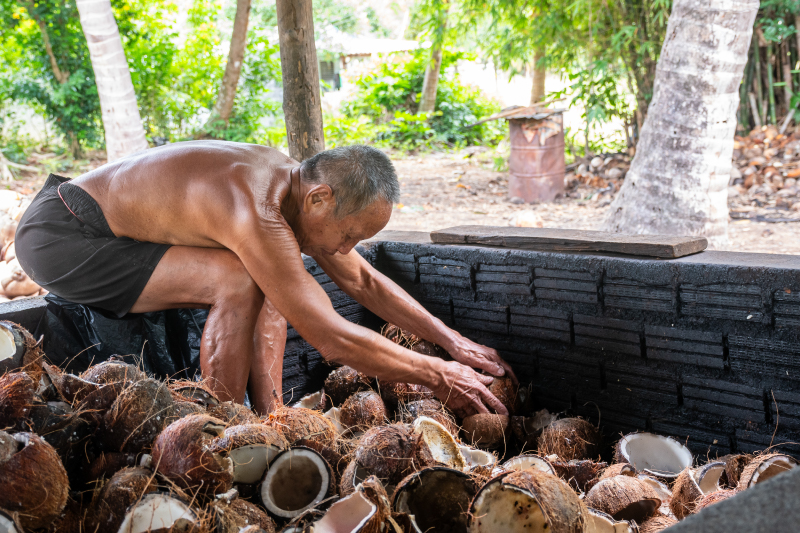
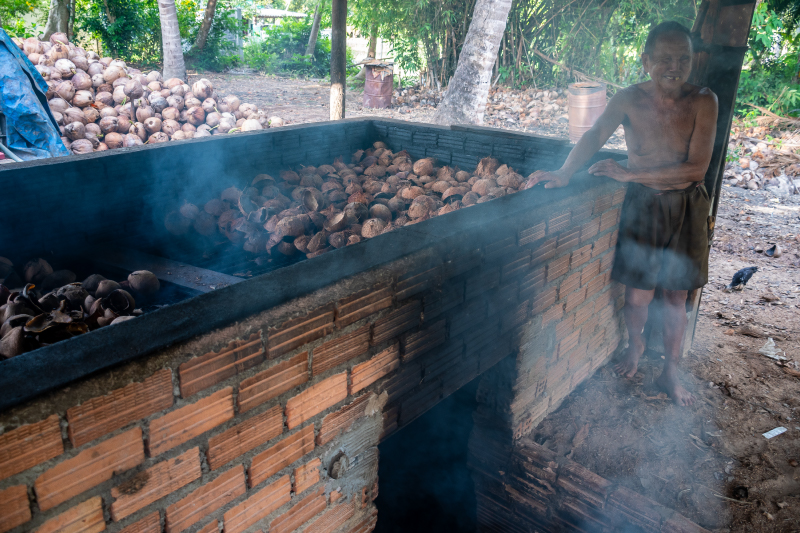
too tall and too brittle to harvest cleanly — these Yokjing does not discard. He roasts them instead, over open fire fueled by coconut husks, in wood-fired ovens that are themselves nearly thirty years old, among the last of their kind left on Samui. He smokes the husks first, then grills the meat for eight hours at a stretch, low and slow, before sending it on to factories that press it for oil — the kind that ends up in pet food and industrial lubricants, in products whose buyers will never know the coconut passed through the hands of a blind man in Lamai.
It is here that his particular gift shows itself most plainly. Ask him how he knows when a coconut is ready — pulled from a fire he cannot see, timed without a clock he cannot read — and he does not have a tidy answer. He simply says he feels it. Five or six hours over the flame, sometimes longer, and his fingers against the flesh tell him what his eyes never could: whether it has dried through, whether the moisture has gone, whether it is ready to leave his hands for someone else’s kitchen or factory line. On a good day, working from six in the morning until five in the evening, he used to turn out 1,200 coconuts by feel alone. These days, the output is lower, he says without complaint, and less work to go around.
Because there is far less now. Disease has swept through the plantations in recent years, and the coconuts have thinned out with it. Samui once had three or four factories extracting oil from coconut meat; today there are none. Where Yokjing used to peel a thousand coconuts on any given day, he now sometimes works just once a month, waiting for someone to come and collect him, since he has no phone of his own to be reached. He accepts this the way he seems to accept most things — with a kind of plain, unhurried honesty. “It’s the only thing I know,” he says, “because I’m blind.” Tiring, some days. But he rests, and he goes back.
Nid, the local chairman of agricultural and eco-tourism, watches men like Yokjing with a certain urgency now that there is growing interest in local tourism. Coconut, he says simply, is Samui people’s life — not a curiosity for visitors, but the thread that has run through the island’s economy for a century, through booms and diseases and vanishing factories alike.
Yokjing does not think of himself as keeping a tradition alive. He thinks of the coconut in his hands, dry or not yet dry, ready or not yet ready. He has never needed his eyes to know the difference. His hands have always told him everything he needed to know.
EXPERIENCE TRADITIONAL COCONUT HARVESTING WITH YOKJING
Want to see authentic local craft in action? Visit Yokjing’s plantation for a hands-on look at traditional coconut processing. Watch expert demonstrations on how coconuts are harvested, peeled, and grilled using time-honoured techniques.
Contact Nid at 089-874-1690