Light on Water
Long before Koh Samui became synonymous with infinity pools and sundowners, the Thai people were already perfecting the art of floating light on water. The Loy Kratong festival — whose roots reach back to the royal courts of Sukhothai — is one of Southeast Asia’s most luminous traditions. As the full moon rises over the Gulf of Thailand this November, we trace the ceremony from its brahmanical origins to the glittering spectacle it is today.
Words: Bella Luna
Photos: Jiraphol Rikshasuta & Koh Samui City Minicipality
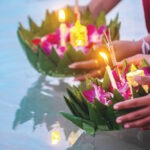
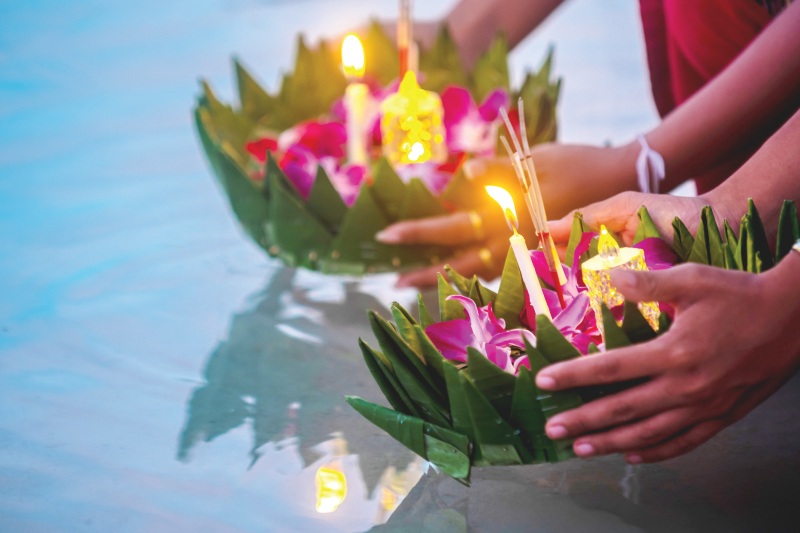
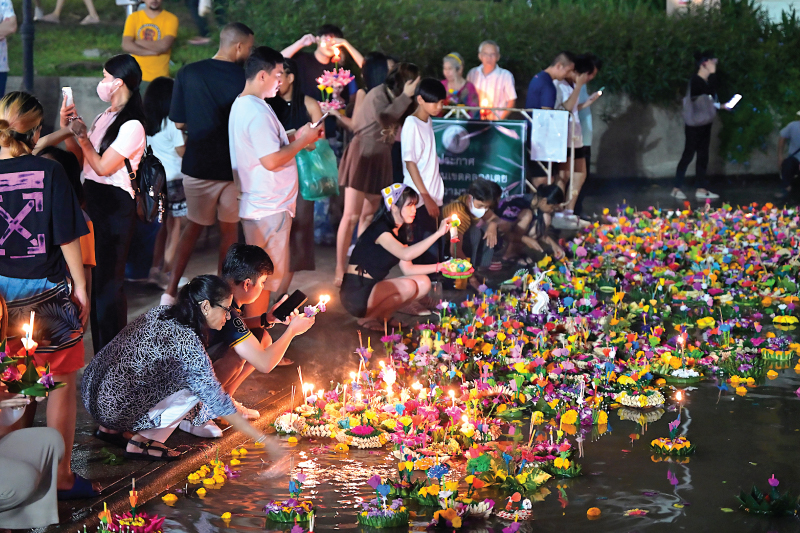
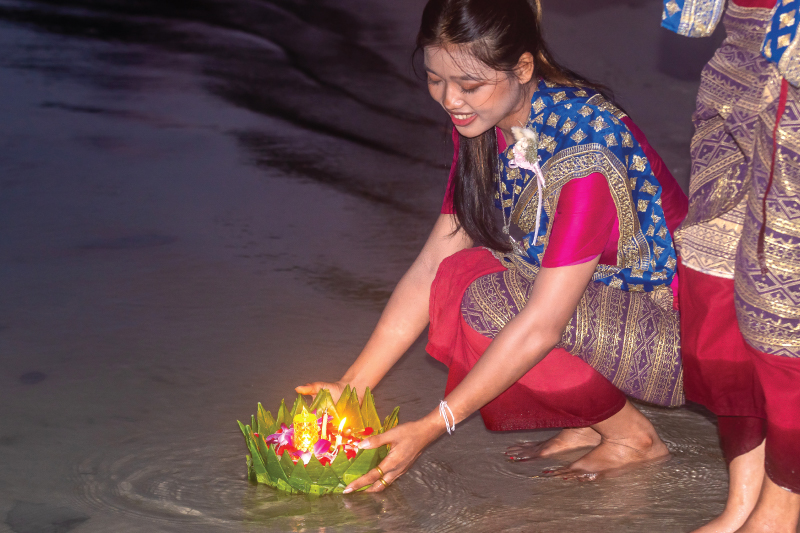
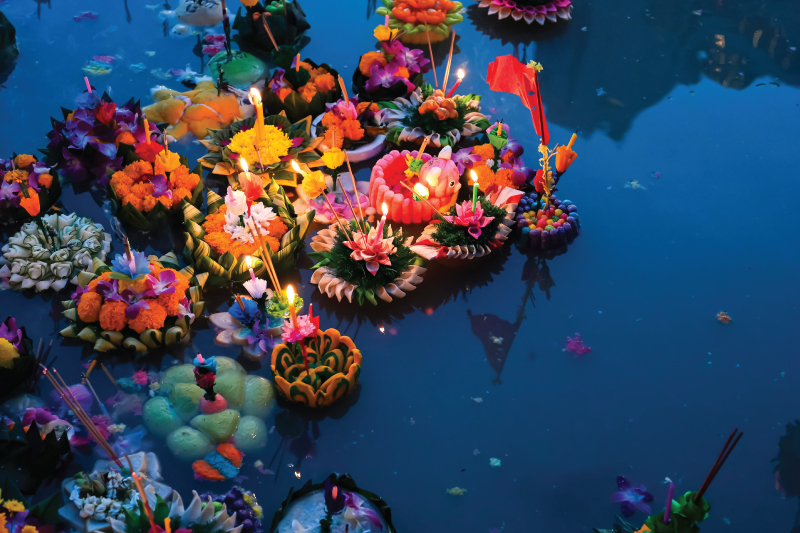
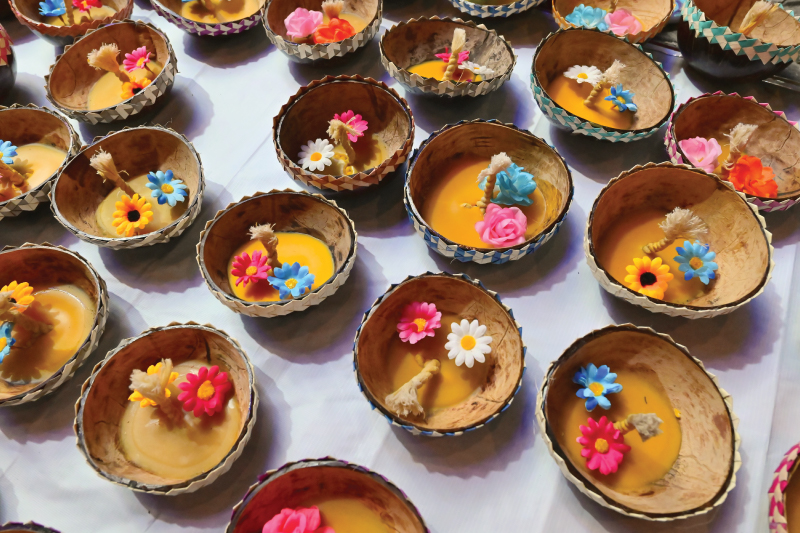
Every year, on the evening of the full moon in the twelfth lunar month, Thailand’s canals shimmer, rivers carry their cargo of light, and on the shores of Koh Samui, a sea of small lotus-shaped vessels – each one cradling a candle, incense sticks, and a small flower offering – are released upon the water. This is the act of Loy Kratong: to float a vessel, which has become one of Asia’s most breathtaking ceremonies, and it is far older than many who practice it today might imaging.
From Sacred Fire to Floating Light
The story begins not with a kratong, but with a kome — a ceremonial lantern — and a ritual known as Pitee Yok Kome Loy Kome, or the Ceremony of Raising and Floating Lanterns. This was, at its earliest, a brahmanical observance: a rite of veneration offered to three of Hinduism’s principal deities — Pra Isuan (Shiva), Pra Narai (Vishnu), and Pra Prom (Brahma). With the adoption of Buddhism, the tradition evolved gracefully rather than disappearing. The washing of lanterns – Chak Kome – was reinterpreted as a terrestrial act of reverence toward the Buddha’s relics enshrined, according to belief, at the Culaman Chedi in the heavens above. The floating of those lanterns downstream became an offering to the Lord Buddha’s footprint at the sacred banks of the Namatha River.
The royal decree that formalised this transformation was unambiguous in its ambition. Warriors of the realm were commanded to observe the full moon of the twelfth month and to release kratongs fashioned in the form of lotus flowers – the sacred symbol of Buddhist enlightenment – as an act of worship at the feet of the Buddha’s image. A ceremony once rooted in Hindu cosmology had found a new spiritual vocabulary, and a new name: Pitee Loy Kratong Song Prateep.
THE AYUTTHAYA REFINEMENT
By the time of the Ayutthaya Kingdom, Loy Kratong had become a matter of royal theatre. The monarch would descend to the water by royal barge, drifting along the Chao Phraya to observe the candlelit flotilla of the royal temples lining the riverbanks. It was an occasion for pageant and pilgrimage, the grandeur of the kratongs reflecting the splendour of the throne itself.
The ceremony, already layered with meaning, carried with another strand of devotion: an apology to Mae Khong Kha, the goddess of rivers and waterways. This acknowledgement – that humans consume river water, bathe in it, and depend upon it daily – remains central to the spirit of the festival today. The act of floating the kratong is, in part, an act of gratitude and contrition.
The RATTANAKOSIN ELABORATION
In the early Rattanakosin period – spanning the reigns of Rama I through Rama III – the floating lantern competition reached its most spectacular form. Craftsmen would construct kome of extraordinary scale and intricacy: replicas of Ruan Chedi (chapel towers), Bot (ordination halls), Wihaan (sermon halls), and the mythical Khao Pra Sumeru, rising eight to nine sok (elbow) wide and ten to eleven sok tall, adorned with electric illuminations and animated by attendants stationed within. The ingenuity was considerable — and so was the cost.
By the reign of Rama IV, the economics of the spectacle had become a concern. Each floating construction reportedly required the labour of twenty of twenty-one monks to manage overnight, making the ceremony both logistically demanding and financially burdensome. The grand illuminated constructions were gradually retired, and the festival simplified — returning, in spirit, to something closer to the intimate Sukhothai practice that had originally given it meaning.
A FESTIVAL FOR EVERYONE
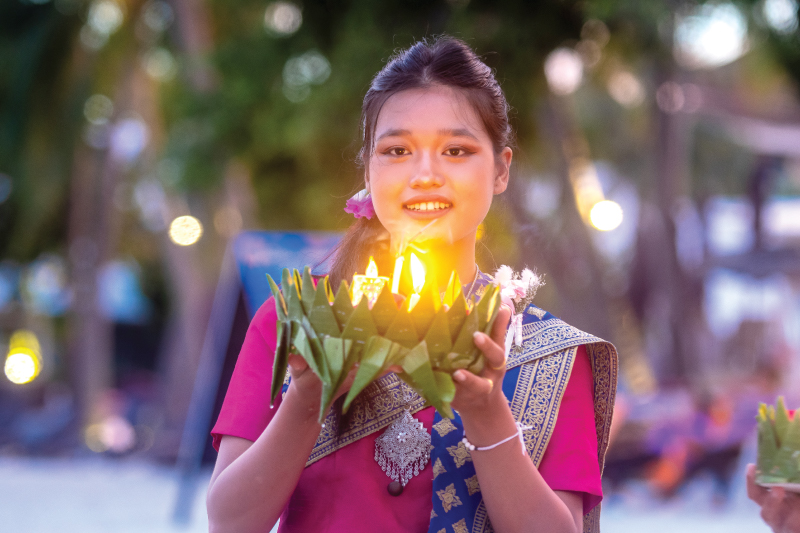
What distinguishes Loy Kratong in its contemporary form is its remarkable democratic character. Though it carries royal origins and ancient spiritual weight, it belongs equally to every person who approaches the water. Modern celebrations have added cheerful parallel events — beauty pageants to crown the Nang Noppamat, a figure drawn from royal legend as the originator of the lotus-shaped kratong — yet the central act remains unchanged: one person, one vessel, one candle, one river.
On Koh Samui, the ceremony carries additional resonance. The island’s own Loy Krathong tradition was formalised in 1964 at Klong Bang Tao, in Tambon Phoo, under the guidance of Pra Khru Sri Wachkhunaphon — now the revered Luang Ta Sri Wach, abbot of Wat Phuttapanya in Bangkok. From that single ceremony, the tradition spread across the island, finding its way into the lobbies of large hotels and the shorelines of private villas — each one, in its own way, continuing a conversation with the water that Thais have been having for seven centuries.
WHAT THE LIGHT MEANS
There is no single interpretation of what the kratong carries when it leaves your hands. Some release worries. Some offer thanks. Some, in the older brahmanical sense, are returning something borrowed — the water that has sustained them — back to
its source. In a country where rivers, canals, and coastline have shaped every aspect of daily life, agriculture, trade, and spiritual geography alike, the act of floating a light on water is both more ordinary and more profound than it might first appear.
As November arrives and the full moon climbs above the Gulf, and as the warm air carries the scent of incense and frangipani across the terraces of Samui’s villas and beachfront restaurants, the kratong you release joins a line of light stretching back to the royal courts of Sukhothai, to the brahmanical temples of an earlier world, and to the patient, enduring surface of the water itself.
Place your offering gently and watch it go.