WHAT THE SEA GIVES
On the eastern shore of Koh Samui, a community of fishermen quietly holds together a way of life that tourists rarely see — and that the world is slowly pulling apart.
Words: Mimi Grachangnetara
Photography: Jiraphol Rikshasuta
Pull back any map of coastal Thailand far enough and a pattern emerges that no resort brochure will ever show you. Before the hotels, before the beach clubs, before anyone thought to put an airport on an island, there were fishing villages. They dotted every shore — the Gulf coast, the Andaman side, the river mouths and the mangrove edges — each one a small, self-sufficient world organised entirely around the sea. The fishermen who built them did not think of themselves as custodians of a tradition. They were simply people who knew the water, who ate what they caught, and who taught their children the same. The village was the economy, the pier was their town square and the tide was their clock.
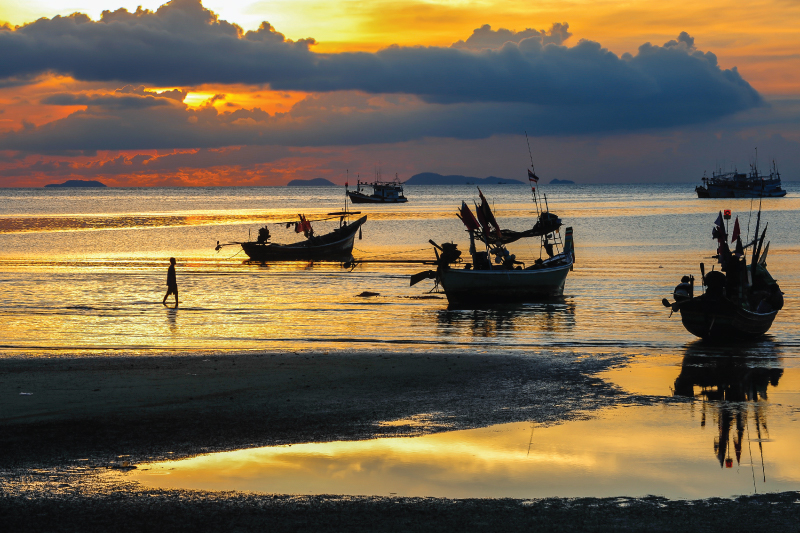
Koh Samui, now one of Thailand’s most visited islands, was shaped by exactly this kind of community long before it was shaped by tourism. And on its eastern coast, in a settlement called Hua Tanon, that original version of the island still exists as a living, working place where men go out before dawn and come home smelling of the sea.
The pier at Hua Tanon is already busy at four in the morning. Piyawit Hae-yong— also known by his nickname “Dum” to anyone who knows him, which is everyone — moves through the pre-dawn dark with the unhurried efficiency of someone who stopped needing to think about this routine a long time ago. Rope coiled, nets checked, engine turned over. He has been doing this since he was twenty. He is fifty- five now, and the motion is in his body the way a language gets in, below the level of conscious thought.
He has five children, and they have given him grandchildren. He was born in Hua Tanon and has built his entire life within a few kilometres of this pier. When you ask him how things are, he considers the question with the seriousness it deserves. “Enough,” he says. Then: “But it could be better.”
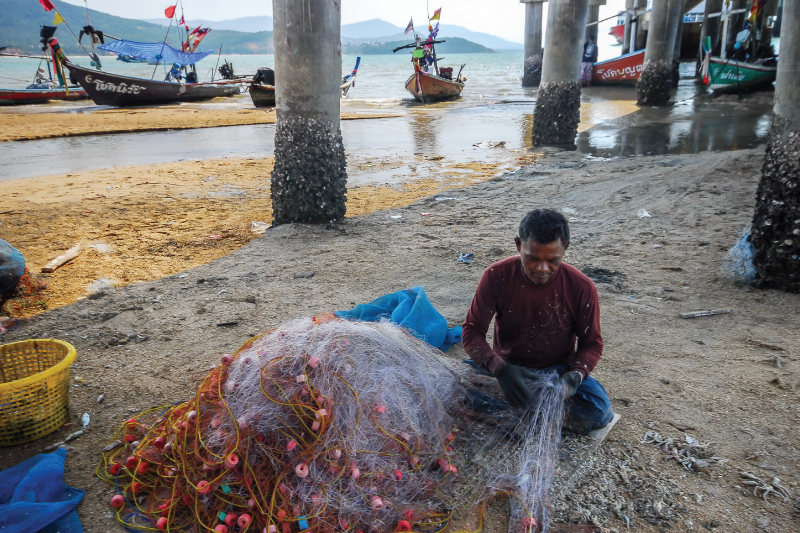
On a good morning, Dum takes his boat out toward Koh Si or Koh Ha — two small islands that sit in the Gulf a short distance from shore. He runs a triple- layer gill net across fifty metres of water, then waits. There is a particular quality to the waiting that experienced fishermen have — alert but still, reading small changes in the surface, the current, the light. By sunrise the net is working. The richest hours come late in the morning, between eleven and noon, when the catch is at its densest. Shrimp, reef fish, whatever the sea is offering that day. Then back to the pier, to the markets, to the business of turning a morning’s work into a day’s income.
In the afternoon, he goes to the workshop. It is a tin-roofed space beside the pier, and it smells of fibreglass resin and old engine oil and salt that has worked its way into everything. A half-finished trawler sits in the middle of it, hull open, waiting. Dum repairs boats here — fixes engines, patches hulls, re-stitches nets. He also builds them. This second profession arrived by necessity, learned piece by piece as the economics of fishing alone became harder to sustain.
The Hua Tanon that Dum grew up in was a different proposition entirely. Fifteen, twenty fishermen worked these waters when he was a boy — perhaps thirty at most. The sea was, in his telling, almost recklessly generous. Pla juad (croakers) and pla tu, the mackerel species that moved through the Gulf in vast schools, came in such numbers that the problem was not finding them but handling the volume. “Too much,” he says, and there is something almost wistful in his smile. “We couldn’t get enough boats out to take them all.”
Those fish are gone now. Not scarce — gone. Dum is honest that he cannot fully explain it. What he can tell you is that where there were thirty fishermen, there are now hundreds. The pier that once had room to breathe is crowded every morning. The sea that once gave freely has grown careful, or perhaps simply tired.
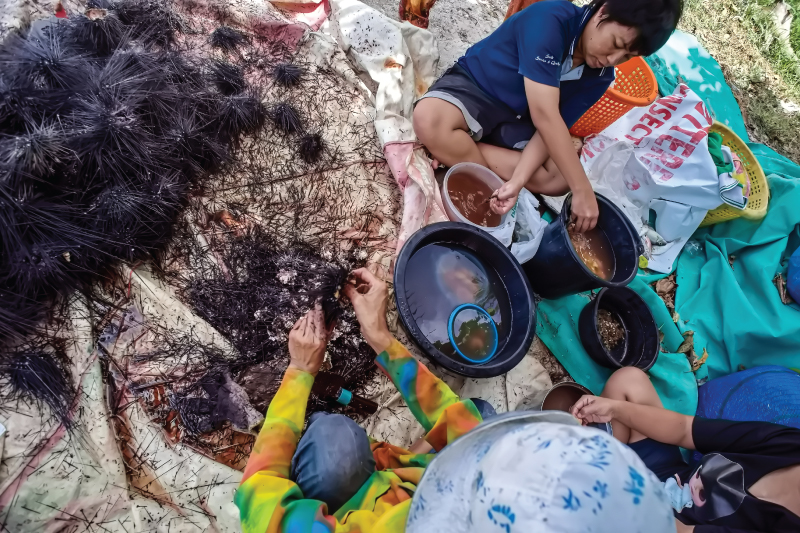
What does not exist yet, and what Dum comes back to more than once in conversation, is an association — some formal structure through which the fishermen of Hua Tanon could pool their leverage, advocate for regulation, pursue the kind of fishery management that might actually reverse some of this. A crab bank, for instance: a nursery system where female crabs are set aside to breed, restoring populations within months rather than decades. It is not a radical idea. It operates successfully elsewhere in Thailand. Here, it remains a conversation that nobody with the right authority has sat down to finish. “We need someone capable,” Dum says — someone who could actually make it run. The knowledge of what’s needed is present. The institutional will is not.
Then the war arrived in the price of diesel. It would be easy, sitting on a sun- lounger on the other side of this island, to assume that the conflict grinding through the Middle East is someone else’s problem in someone else’s geography. At Hua Tanon pier, that assumption does not hold. Fuel costs — already the largest variable expense for any small fishing operation — climbed to levels that turned some trips from marginal to impossible. The arithmetic of a day at sea changed: the distance you could afford to travel, the hours you could afford to spend, the viability of going out at all. Some mornings, Dum stays ashore. Not because the sea is rough or the season is wrong, but because the numbers simply will not work.
“All fishermen are affected,” he says. Extremely, is the word he uses. It is not a word he reaches for casually.
On those days, there is the workshop. There is always something in the workshop that needs doing — a net with a torn section, an engine that is running rough, a hull that someone has let go too long. Dum moves between the two vocations with the pragmatism of a man who understood early that the sea alone was never going to be a complete answer.
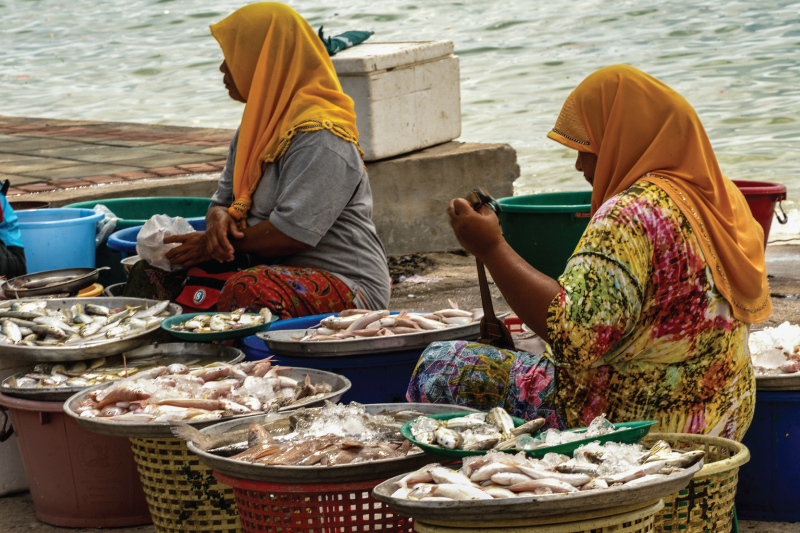
The Hua Tanon market, on a morning when the catch has been good, is one of the most honest places on Samui. Chalamet (pomfret) — a white-fleshed fish of real quality — commands the best price and sells fast. Pla insee (King mackerel), squid, crab when there is crab: the stalls hold whatever the night produced, priced without theatre, handled without ceremony. Visitors who find their way to this side of the island — and not many do — tend to go quiet when they arrive, the way people go quiet when they stumble into something that is clearly not meant for them but that they are glad to have found.
Dum will be somewhere nearby. At the market, or in the workshop, or down at the waterline with his hands on something that needs fixing. He is not a figure from a vanishing world, though it would be convenient to frame him that way. He is a man adapting — as Thai coastal communities have always adapted — to conditions he did not choose and cannot fully control, holding his family and his trade together through a combination of stubbornness, skill, and the kind of practical intelligence that does not show up in any measure of economic development but that keeps things running regardless.
What Hua Tanon actually needs is not visitors who find it charming. It needs an association with the standing to negotiate, the structure to implement a crab bank, the voice to push back when policy ignores the people most directly connected to the sea. Thailand’s fishing villages were never just picturesque. They were the infrastructure of an entire coastal civilisation — the places that fed the country, that read the weather, that understood the water in ways no government agency has fully replaced. Hua Tanon is not a remnant of that. It is its continuation, fraying slightly at the edges, still holding.
The boat goes out at four. The net goes in at fifty metres. The sea gives what it gives. For now, that has to be enough.