THE CRAB KEEPERS OF KOH SAMUI
A quiet conservation effort on Koh Samui is helping replenish Thailand’s coastal waters.
Words: Bella Luna
Photography: Jiraphol Rikshasuta
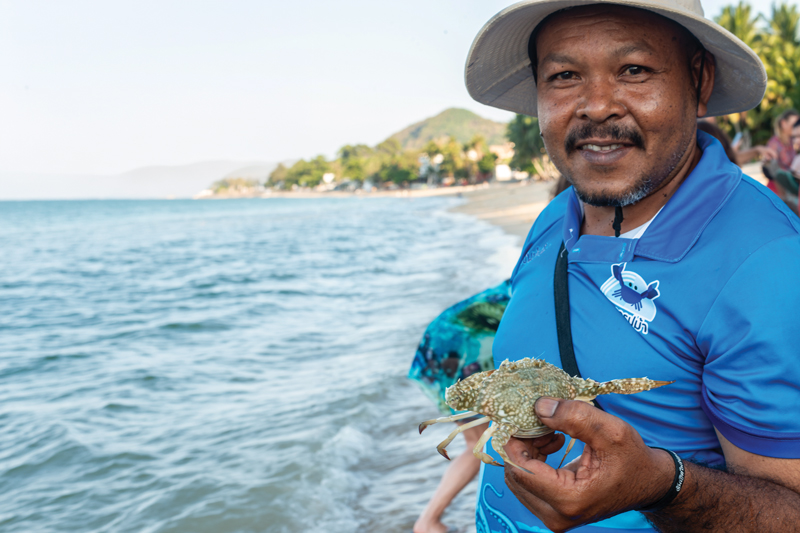
If you want to understand a coastal island, skip the beach clubs and follow the fishing boats home. A fisherman’s village is the true heart of any island province; the place where the tides are read as livelihood, where the sea is not scenery but obligation. Koh Samui’s heart beats loudest in the communities along its quieter shores, where men like Narongsak Wilailak have spent their lives watching the water, and where they noticed, long before any government report confirmed it, that something was going quietly wrong. The crabs were disappearing.
Six years ago, Narongsak helped found the Samui Crab Bank — a collaborative initiative between local fishing groups and government agencies, born out of a single, pressing observation that the sea was running out. “All marine life is in shortage,” he says simply. He lists the casualties with the fluency of someone who has watched them disappear: pla tu, the short mackerel that has fed coastal families for generations; squid — both pla muek wai and pla muek sai; and above all, poo maa, the flower crab, whose numbers had fallen so sharply that fishermen were returning with little to show for long days at sea.
The crab bank is not a commercial enterprise. That point matters to Narongsak, and he makes it clearly. The operation runs on community commitment, not profit — a distinction that shapes everything about how it functions.
Here, female crabs — their eggs fertilised and visibly swollen in bright orange masses beneath their abdomens — are brought to the bank by fishermen rather than taken to market. Supervised tanks, they release their eggs in a controlled environment. A single mother crab carries up to one million eggs, though reality is more modest: roughly 50 to 60 per cent will be viable. The rest become food for other marine creatures, swallowed quietly back into the chain of life.
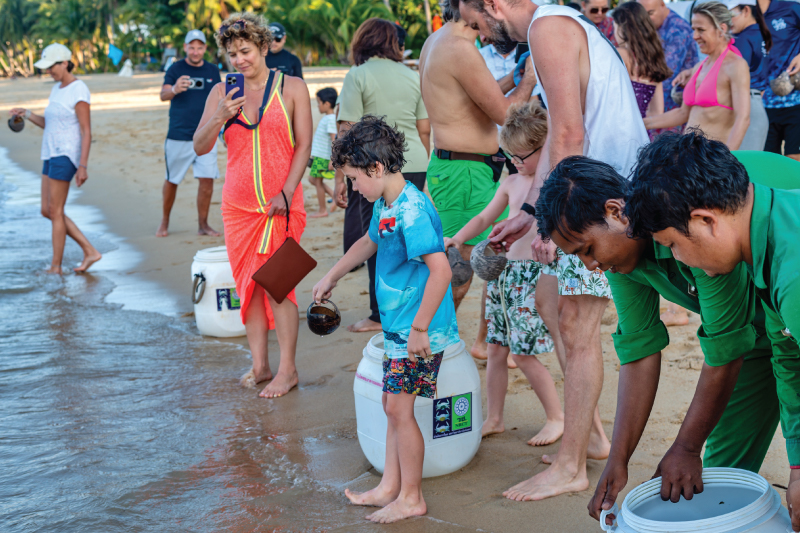
“Eggs hatch within one to three days. At 15 to 20 days old, the larvae become juvenile crabs, small enough to drift on the current, carried wherever the Gulf of Thailand chooses to take them,” Narongsak explains. “By day 20, they have transformed into recognisable crabs. Three months on, they reach harvestable size.” At six months, a female is mature enough to become a mother herself — potentially returning, one imagines, to produce the next generation of bank deposits.
Each month, at peak capacity, the bank releases between 30 and 40 batches of juvenile crabs into the open sea. On a good day, there is a new mother crab ready every 24 hours. “We can release one each day,” Narongsak says. The monsoon season, counterintuitively, brings the best conditions: abundant food in the water column means higher survival rates, and the crabs breed with particular vigour.
The evidence of impact is not found in government reports or environmental audits — at least not yet. It lives in the conversations Narongsak has with fishermen. “They say they have more,” he says. “The fishermen have more of a living.” After six years, that testimony carries weight. These are people with no ideological stake in conservation, no reason to report improvement unless they feel it in their nets and in their incomes.
The bank’s work is also shaped by awareness of the legal frameworks that govern fishing in Thailand. There are regulations stipulating minimum net mesh sizes — trawlers must allow openings of at least four inches, giving juvenile crabs the chance to slip through and survive to maturity. But laws only work when the sea has enough adult crabs to protect in the first place. The bank, in this sense, is doing the upstream work that legislation alone cannot achieve.
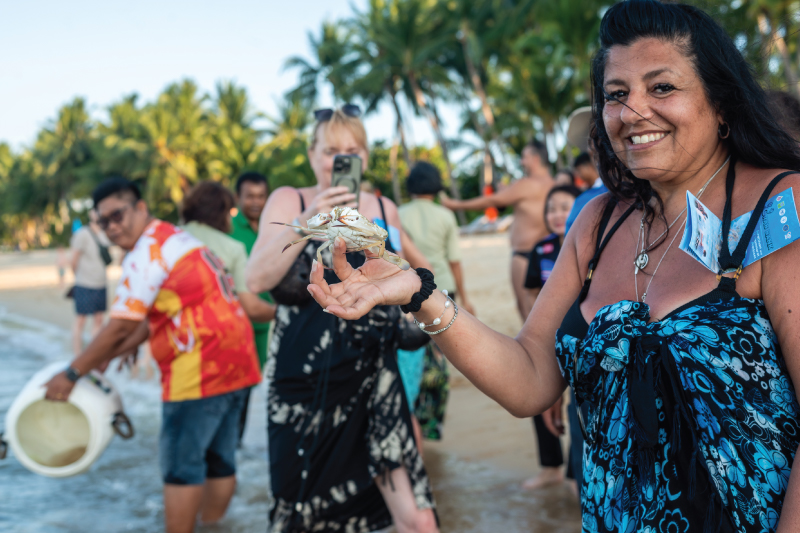
Koh Samui is better known for its beach clubs and wellness retreats than its marine ecosystems. That contrast — the island’s polished tourist surface against the fragile, working sea beneath it — is precisely what makes projects like the crab bank so important to amplify. The fishermen who bring their female crabs to the facility instead of selling them are making an economic sacrifice in the short term, an act of collective trust in a future they may not fully see.
Narongsak is not a man given to grand rhetoric. But there is something quietly radical in what he and his community have built: a local answer to a global problem, assembled without fanfare on a shoreline most visitors never think to visit.
What the sea gives, it can just as quietly take back, and Narongsak knows this. So does every fisherman who has watched a full net become an empty one, season by season, with no explanation beyond the obvious. The crab bank is not a solution so much as a reckoning — a community deciding, together, that the bargain with the ocean is worth honouring. That the debt is real, and that someone has to pay it forward.