
Rabbit Run
Once a staple of Thai kitchens, the coconut- shaving rabbit is quietly hopping out of daily life and into the realm of heirloom—where memory matters as much as function.
Words & photos: Mimi Grachangnetara
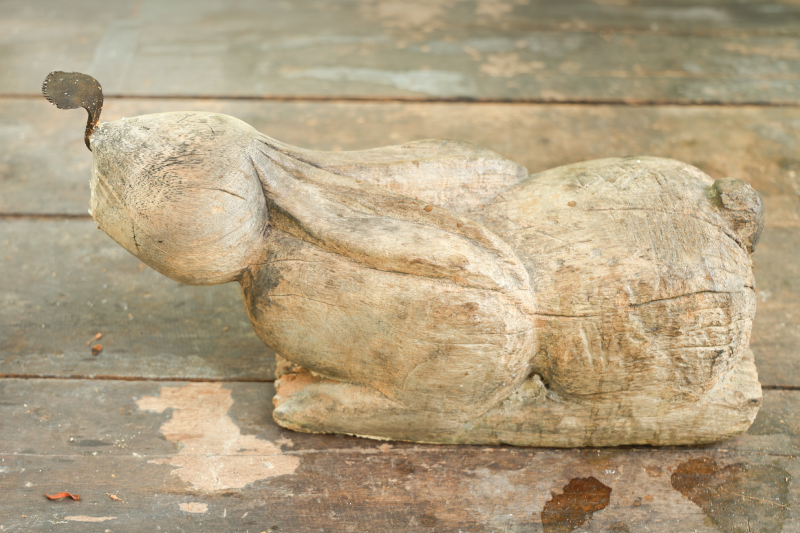
Coconut is as essential as rice for Thais, since it is the source of one of the main ingredients in Thai cooking – coconut cream and coconut milk. It is no wonder why the humble kratai kood maprao—literally “coconut-shaving rabbit”—once occupied a quiet but central role in the Thai kitchen. Before stainless steel gadgets and plug-in graters found their way onto countertops, this carved wooden implement did the hard work of turning firm white flesh into fine, fragrant shavings. It was a tool, certainly, but also a small sculpture—part utility, part folklore.
The form was unmistakable. A low wooden bench extended into the stylised body of a rabbit, its head often gently raised, ears alert. At the front protruded a serrated metal blade, glinting like teeth. The user would sit astride the wooden body, steadying themselves as they pressed half a coconut against the blade, scraping in steady arcs. The motion required patience and a practiced hand. Applying too much pressure and the flesh would clump, too little and the process would drag. Over time, this skill became second nature—scrape, turn, scrape—until a soft mound of coconut shavings gathered below, ready to be pressed into milk for Thai curries, desserts or ceremonial dishes.
What distinguished the traditional kratai kood maprao was not merely its function, but its character. Each piece bore the mark of its maker. Some rabbits were playful, with exaggerated features and painted details; others were pared back, almost abstract, their beauty found in proportion and grain. In coastal provinces and inland villages alike, artisans carved these forms from hardwood, embedding local identity into an everyday object.