Up the Trunk
Passed down through generations and rooted in everyday rural life, coconut tree climbing is less a daring feat than a patient craft – one that reveals how tradition, skill and respect for nature still shape the way coconuts are brought down to earth.
Words: Sua Pon Nam
Photos: Nattapol Suvapat
The ascent of a coconut palm has long been a skill honed in groves lined with swaying palms. For generations, this knowledge has been passed down from parent to child, neighbour to neighbour. The techniques are taught low to the ground at first, learned by watching and by doing, with elders keeping a careful eye on posture, rhythm and restraint. It is a practical craft, certainly, but also a cultural one – part of the everday choreography of rural life, bound up with food, work and seasonal routines.
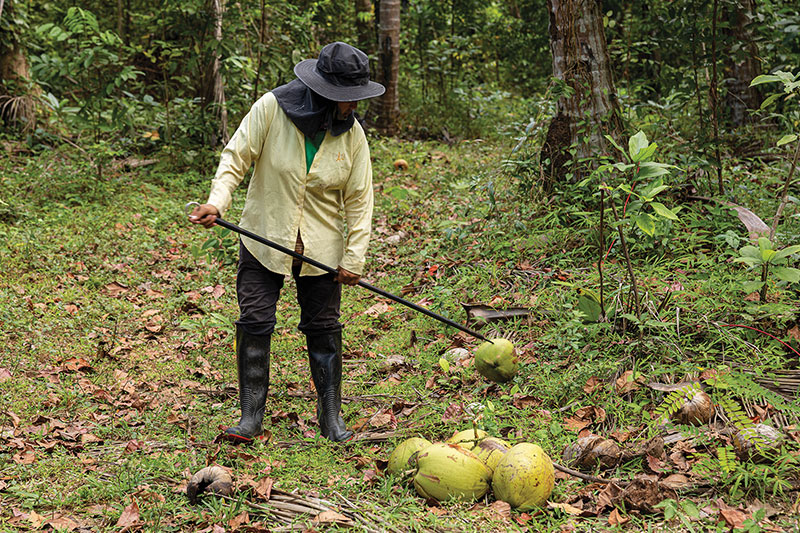
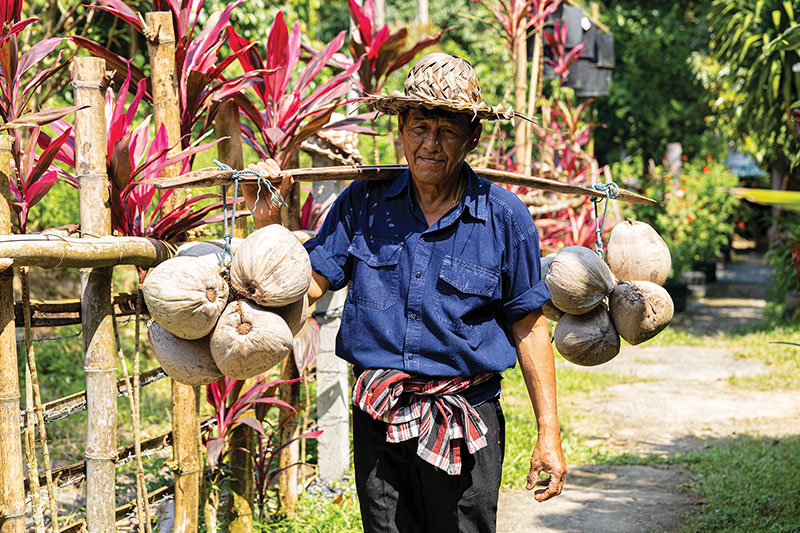
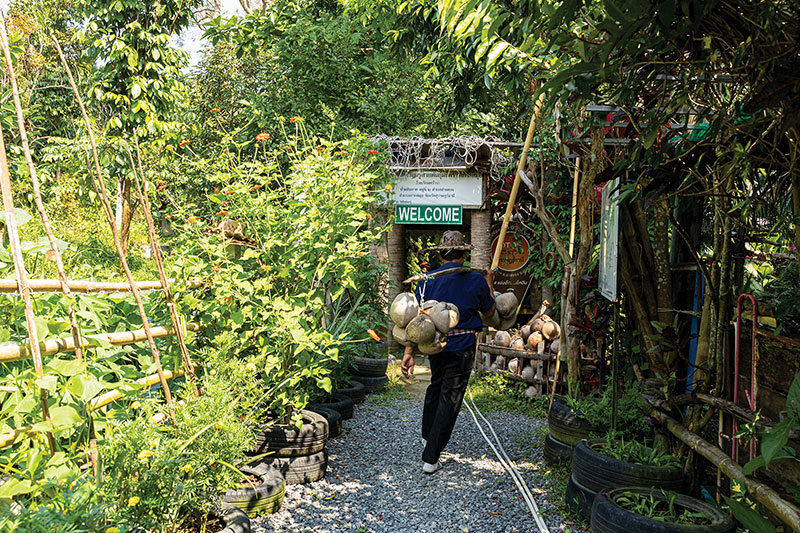
The Coconut Museum on Koh Samui has carefully documented this lineage with photographs, illlustrations and oral histories that chart the evolution of the practice. The exhibits show how climbers traditionally relied on simple, locally-made aids and an intimate familiarity with the palm itself. The emphasis, as the museum makes clear, was never on conquering height but on working with the tree, returning safely to the groudn and leaving the palm unharmed.
These days, as visitors grow more curious about where coconuts actually come from (hint: not supermarket shelves), tree-climbing is increasingly framed as heritage rather than spectacle. It is admired as a reminder that many essential skills predate modern equipment and formal instruction, surviving instead through continuity and care. In a world hooked on shortcuts and speed, the coconut climber offers a refrsehingly different message – that some knowledge is best learned slowly, pracitised carefully and respected for the generations who inched their way up the palms with confidence, caution and quiet skill.
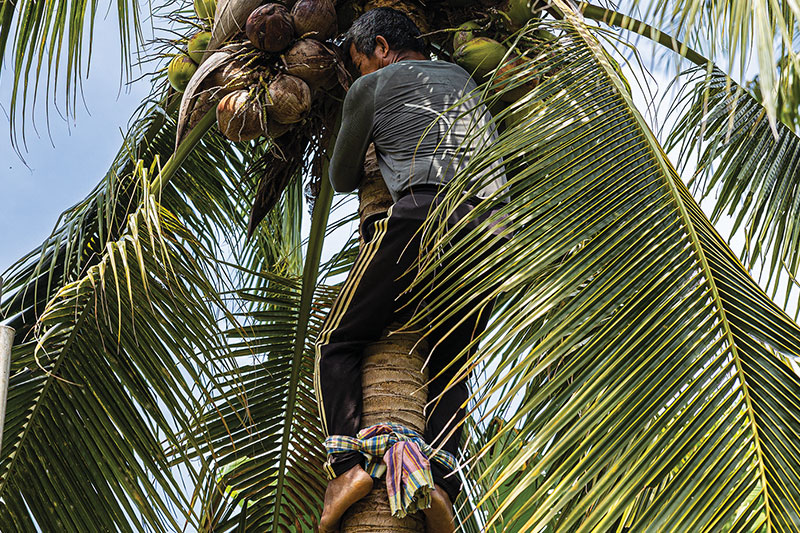
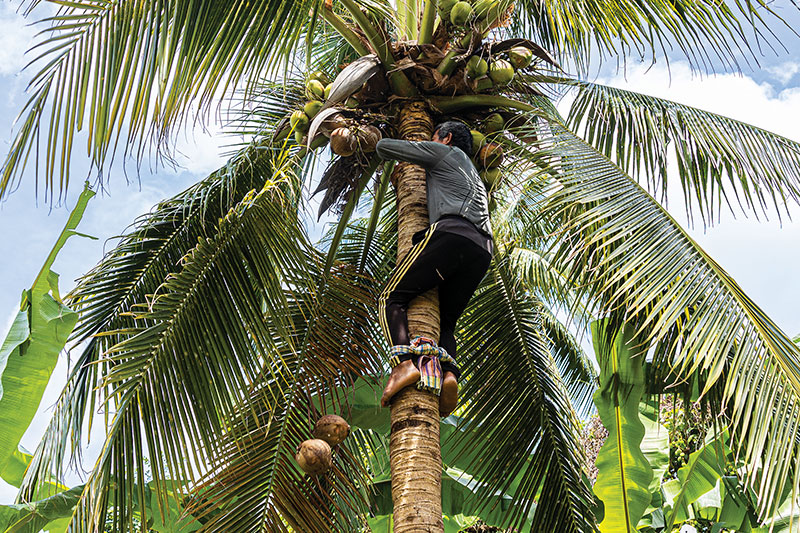
Traditionally, climbers relied on little more than a loop – often made from jute, cloth, leather or rubber – fashioned to brace the feet against the trunk. The device is simple but effective: a band wide enough to encircle the palm, snug enough to create friction. With feet placed inside the loop and pressed firmly to the bark, the climber grips the trunk with both arms, advances the band incrementally upward and follows with a coordinated lift of the body. It is a rhythm learned through repitition: secure, step, life; secure, step, lift.
Those new to the craft are advised to begin low and stay low. Practice is conducted within arm’s reach of the ground, where errors are instructive rather than catastrphic. A companion stands by – not as audience but as insurance. Coconut palms can rise to daunting heights and the margin for error narrows with every metre gained. The rule, passed down as firmly as any technique, is simple: do not climb beyond your ability. Descent demands as much focus as ascent, with the foot loop again bearing weight as the climber lowers themselves carefully, one measured movement at a time.
There is, of course, a reward at the summit. The fronds part to reveal a view across tiled roofs and fishing boats; the crown of the palm offers a surprisingly sturdy perch. A freshly cut cocontu – cool, heavy and improbably full of sweet water – is both trophy and refreshment. Yet even here restraint applies. The tree must not be scarred in the process. Spiked shoes and metal grips, while expedient, pierce the trunk and leave it vulnerable to insects, fungus and rot. Rangers and orchard owners alike discourage such methods, favouring rubberised surfaces that increase friction without inflicting damage. Improvised solutions – strips cut from discarded tyres and fastened securely to gloves or foot loops – are common, provided they are fixed firmly enough not to slip.
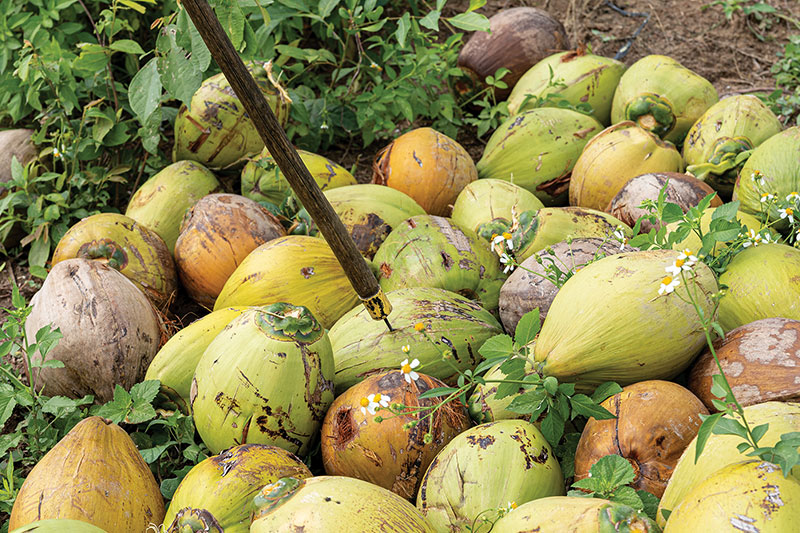
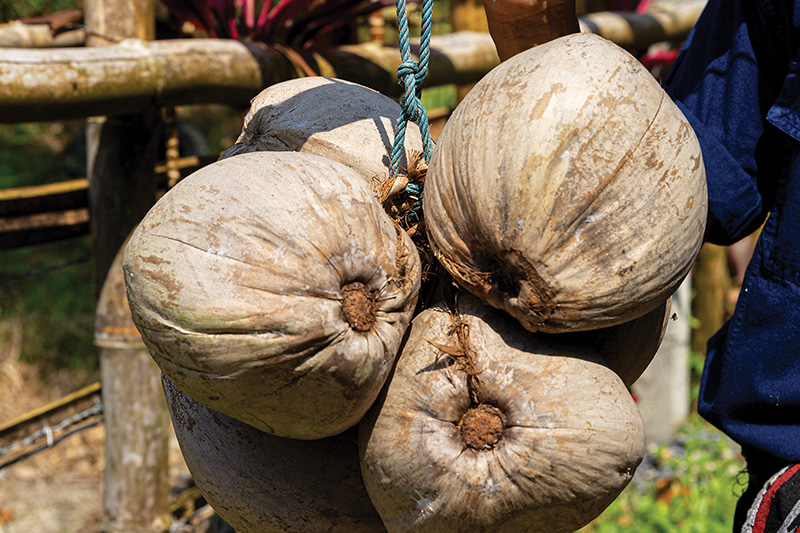
Safety, in this disceipline, is neither optional nor dramatic. Gloves guard against splinters; fatigue is answered by locking the feet around the trunk and pausing. Beginners are counselled to attempt shorter palms first, ideally those whose lower fronds can be grasped while standing on solid ground. And always, someone remains below, ready to call for help shoud a grip falter. The higher the climb, the harder the fall – a fact stated plainly and respected absolutely.
As travellers become more interested in provenance – in understanding how food makes its way from palm to plate – coconut climbing is being recast as cultural heritage rather than everyday labour. It serves as a reminder that many vital skills existed long before harnesses and dydraulic lifts, preserved instead through patience, observation and lived experience.
While skilled climbers are now less common on Koh Samui, the practice has not disppeared. Instead, it is gaining renewed attention among younger islanders, who regard it as a form of local wisdom worth sustaining. What was once routine agricultural work is increasingly recognised as a choreography shaped by climate, landscape and continuity – carried out with assurance, restraint and quiet expertise.